
Table of Contents Show
When Dating Followed a Script
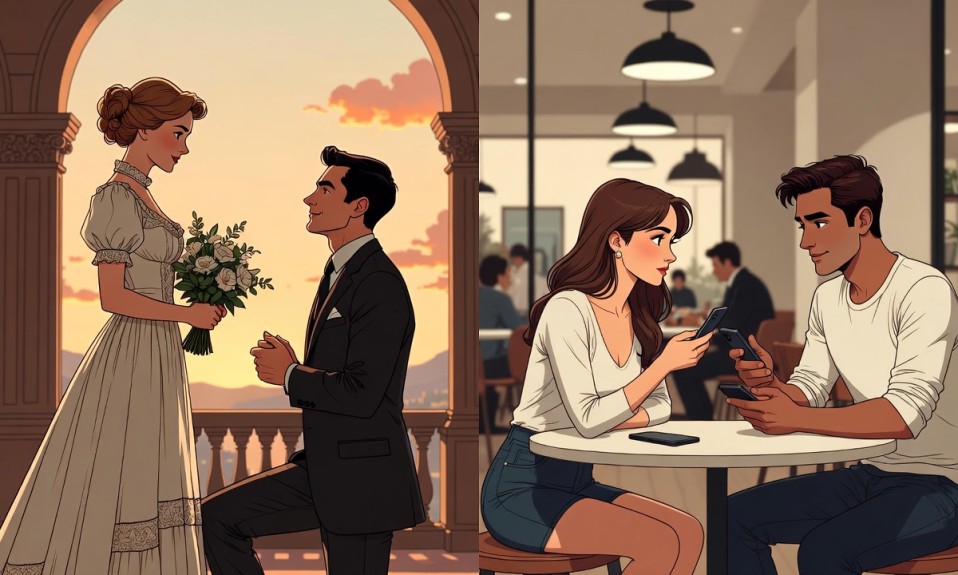
Not so long ago, dating came with a clear structure. Courtship was guided by social rules, family involvement, and shared expectations about the future. Relationships unfolded slowly, often under supervision, and emotional expression followed established norms.
These rituals weren’t just about romance. They were about stability, community, and predictability. Love, when it emerged, was often built gradually through familiarity and shared responsibility rather than immediate emotional intensity.
While this model limited personal freedom, it provided emotional scaffolding — a clear sense of purpose and direction in forming relationships.
The Shift Toward Romantic Individualism
As societies modernized, dating began to center on personal choice rather than obligation. The 20th century introduced the idea that relationships should serve individual happiness, emotional fulfillment, and personal growth.
Dating became exploratory. People were encouraged to discover what they wanted, who they were compatible with, and how love should feel. This freedom transformed intimacy, allowing emotional expression and romantic desire to take center stage.
At the same time, the removal of structure placed more responsibility on individuals. Without clear scripts, people had to navigate uncertainty, rejection, and emotional ambiguity on their own — a challenge that still defines modern dating.
Technology and the Rise of Swipe Culture
The arrival of dating apps reshaped connection more dramatically than any cultural shift before it. Romance became accessible, immediate, and abundant. A potential partner was no longer introduced through shared circles but surfaced through an algorithm.
Swipe culture emphasizes first impressions, speed, and choice. While this creates opportunity, it also introduces a new tension: when options feel endless, commitment can feel optional.
Psychologically, this environment encourages comparison and optimization. Instead of exploring one connection deeply, many people remain half-invested, scanning for something better just one swipe away.
The Paradox of Choice in Modern Dating
An abundance of choice can quietly erode satisfaction. When people believe a better option is always available, it becomes harder to stay present with the person in front of them.
This doesn’t mean dating apps are inherently harmful. Rather, they require intentional use. Without clarity about values and goals, swipe culture can promote surface-level engagement and emotional burnout.
Depth is still possible — but it requires slowing down in a system designed for speed.
Emotional Intelligence as the New Dating Skill
In the absence of formal rules, emotional intelligence has become essential. Successful modern dating depends less on following a script and more on understanding oneself and others.
Self-awareness helps people recognize patterns, needs, and emotional triggers. Empathy allows partners to navigate vulnerability and difference with care. Clear communication replaces unspoken assumptions that once guided courtship.
Where older systems relied on structure, modern dating relies on skill.
What We’ve Gained — and What We’ve Lost
Today’s dating culture offers freedom, diversity, and choice. People can pursue relationships aligned with their values rather than social expectation. Yet this freedom can also feel overwhelming.
What’s been lost is not romance itself, but shared pacing. Where courtship once slowed connection down, swipe culture accelerates it — sometimes faster than emotional readiness allows.
The challenge of modern dating is learning when to pause, when to engage deeply, and when to choose presence over possibility.
Moving Forward With Intention
Dating culture will continue to evolve alongside technology and social values. The future likely lies not in rejecting modern tools, but in using them more consciously.
By combining choice with intentionality, and freedom with emotional responsibility, people can create relationships that feel both authentic and sustainable.
The form of dating may change, but the desire underneath it remains the same: to be seen, chosen, and connected.